Thursday, May 23, 2013

Middle Provo River Fishing Report: May 23: Rust, Wind, Water Levels, and Water Temp.


It is hard to believe that the last time I fished the Middle was in early to mid February. Given the increased traffic on the Middle as the weather warms, I tend to prefer cold weather fishing. There are some positives that I can get use to though, such as not having to break free the ice from guides every 6 or so casts, having to thaw my net in the river to make it usable, or snow shoveling a path to free my vehicle.

Yesterday's outing featured a mix of good and bad conditions. The wind was tenacious and casting was difficult--very difficult to fish the surface and challenging to dead drift. Water levels, despite last week's abrupt temperature increases, were only slightly higher than the levels I prefer. I placed my water thermometer in a shallower section of some riffles and after nearly forgetting and then struggling to find it nearly 30 minutes later, it read 48 F. Because of the wind, I did not observe much insect activity. I did observe some surface activity--looked to be smaller sized fish taking insects off the surface in a pool that was sheltered some from the wind. True the Middle Provo's form, there was an impressive amount of insect activity on the river bottom. I turned over a few rocks and spotted several baetis nymph, their overall size being the largest that I can recall. There were plenty of midges in their larvae stage, which I observed when freeing my fly some submerged sticks throughout the day.

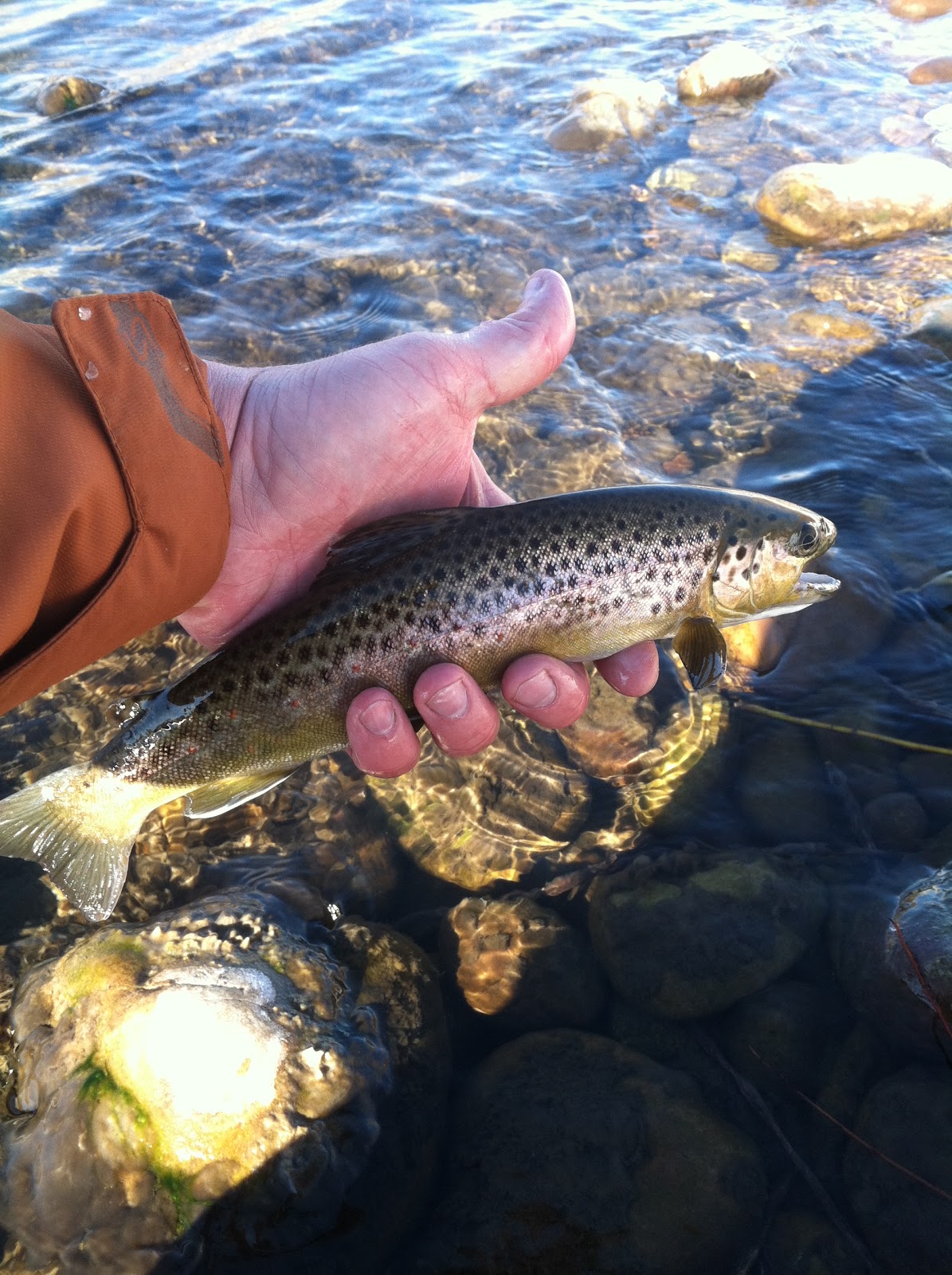
As for the fishing, I managed to catch three under aged browns. My wife's uncle, an all-around good guy from Montana, was in town and I spent a portion of the day semi-guiding--his first time fly-fishing. His two dogs, Dudh and Lukla also added a dimension of difficulty to the trip, but it's all about having fun and the lot of us certainly achieved that. I ran into a gentleman named Walther and we chatted some. We swapped some flies, shared some stories--some true, and went about our ways. He was also nymphing and confirmed that it had been slow. I also recognized a familiar face from last summer. I can't recall his name, but I believe he attempted to net a fish for me--fish ended up breaking free. Anyhow, he showed up late and left early.

Possible outing next week. Nothing boils my blood and gets me more motivated than a slow outing. The vulnerabilities are already starting to creep in and I consider them an important aspect of fishing, as they stir the battle within. Good luck on your outings! 

Friday, February 22, 2013

MIA: Outing on the Horizon

Been a busy month at work. The Cottonwoods are in my backyard and it has been difficult to view them, knowing that on the other side and just a tad further south, the Middle Provo is waiting. I am sure a few of you have been able to keep it company. Enjoying a robusto on its banks, breaking the ice off your guides, and following the river, in search of lethargic tophies holding in their winter spots.

There's a bit of a break in my schedule next week and I plan on rekindling my relationship with the Provo. I will be using sow bugs and may try a few midge patterns. Weatherman says there is a snowstorm on the horizon and I am hoping to be the first to fish the Middle after it has passed. Hope to have a goood post with pics next week. 

-Brendan 

Wednesday, January 16, 2013

January 16, 2013: Middle Provo Fishing Report: Excellent Fishing and the Cold Continues.


Morning--Upon Arrival


Evening--Prior to Departure


Nearly two weeks have passed since my last outing on the Provo River. Salt Lake City was hit with heavy snow and now that the storm's passed, we're left with nearly record breaking temperature lows. Some of my favorite winter fishing conditions occur following a storm. For one, there's only a few troutbums that seek the harder to access spots, which requires tromping through powder that feels twice as deep with waders on.  Yes, there's solace to be found in winter's isolation. As a bonus, once a snowstorm has passed through, there's usually no more than a gentle breeze to contend. These attributes earn high marks in my book of preferences for fishing. A final note: If you drive a car, don't forget your snow shovel.


Fish are taking grayish sow bugs and cream colored UFOs--all that I used today. I placed my thermometer on a submerged rock and unknowingly bumped it with my boot. I was able to track it down, which involved turning over a handful of rocks and I happened to catch sight of several baetis nymphs, about a size 18.  Fortunately, I was able to locate my thermometer and today's Middle Provo temperature reading was 37 F. The fishing peaked in the morning and dropped off noticeably once the cloud cover burned off. As noted in previous reports, browns are holding in deeper, slow moving water. If you move to riffles and add a few splitshots, you may a induce a mature Mountain Whitefish to take a UFO. This species feeds actively during the winter, more so than trout, and you're likely to find yourself with a more than worthy opponent on the line. Case in point, while I was able to haul these beauts in with moderate effort, I hooked into a mature whitefish that tanked back and forth, a warpath that my little midge couldn't sustain. R.I.P cream colored UFO.


Friday, January 4, 2013

January 3, 2012: Middle Provo Fishing Report: Cold Weather, Sow Bugs, and The River to Myself


Middle Provo--It's as cold as it gets on the Provo right now. Yesterday's morning temperature registered in the single digits and it certainly took a toll on my gear. The metal hardware that connected to my net's magnetic-releases failed and it was a small miracle that I didn't lose my net to the river. If you fish the Provo this time of year and use a quick release set-up, spare yourself the issues I've experienced, and ditch the factory rings that connect to each of the magnets. The metal rings are prone to straightening out after repeated use in cold weather. Though it's bulky, I like to wear a medium-sized backpack and until the weather warms up, I'll be carrying my net "guide style."


I meant to take a reading of the water temperature, but managed to forget. Yesterday was my first day of filming on the Provo and I was a little preoccupied between setting up, taking down, setting up, and taking down the cameras all day. The added dimension to my outing instilled in me a healthy level of respect for outdoor videographers, especially the ones that go at it solo.


As for the fishing, it was superb. Gray sow bugs elicited action all day, which included my re-acquaintance with a very large brown from last week's trip--at least I believe it is the same fish. Also, by using sow bugs, you're likely to catch the occasional mountain whitefish, which are a highly underappreciated fish on the Provo. Going back in memory to a late summer outing on the Lower Provo, I had on my line, perhaps, the largest fish overall--in length and girth, since my move to Utah. I say "perhaps," because I was unable to land him after a considerable period that saw me at the mercy of this fish's will. I did manage to get rather close to netting him, but made the fateful mistake of missing him with my net on the first pass, and then grabbing my tippet, which resulted in him breaking loose.


While all of this was happening, several anglers that had been fishing downriver from me, observed the epic battle, made their way towards me, and offered to help land the fish. One of the anglers caught sight of the whitefish, from the opposite side of the bank, and bemoaned that it wasn't a brown. These fish are beautiful and deserve respect in their own right. Their presence is an indicator of river's overall health and I plan on writing a short piece profiling their importance to the Provo River's ecosystem...hopefully it won't be too much of a bore.


Saturday, December 29, 2012

December 28, 2012: Middle Provo Fishing Report: Water Levels, Temp., & Questioning my Use of a 5 wt.


The Middle Provo saw its water temperature dip under 40F (39.5F) for the first time this winter. A reputable website just reported that water temperatures on the Middle Provo are 42 F. Unless my thermometer is broken--brand new, I am a little miffed by their report. Water levels continue to be optimal--consistent with previous reports, and quality fish can be found in holding water and in the middle to latter half of runs. After thoroughly fishing one of my favorite runs, I grabbed several submerged branches, in order to inspect subsurface insect activity. The number of midges that can be found on a single branch is truly remarkable. By running a branch across your hand, you can observe the light bodied midges for yourself--maybe take a picture and share, as I keep forgetting to. Light, cream-colored UFOs, as small as you can tie on, will produce quality fish when presented in a dead-drift.


Fishing continues to be excellent and I managed to catch and successfully land a 22 inch brown on a UFO. Given the river's temperatures, he was not too difficult to bring in and I was able to release him before he knew what hit him. I managed to take several photos and you'll see that this good 'ol boy has a badly damaged jaw--I assure you it's not from the UFO. Once home and reviewing my notes and taking a closer look at some of the photos, and again noticing his damaged jaw, I found myself reflecting on my approach to fly-fishing during the summer, which has been partly documented in this blog. Simply put, I am wondering whether the use of my 5wt rod has left many large browns with significant injuries, or even worse. During the summer and its warmer water temperatures, some of the browns pack enough gusto that it takes an uncomfortable amount of time to land and release one--well over 15 minutes. Even then, I have experienced about a 50%, or maybe even slightly less, landing success rate, which often leaves me wondering how long would it have taken to land the fish. Sure, it's exciting to feel the brute strength and witness a large brown making rhinoceros-like charges up and down the river, but at some point, I have found myself silently swearing in hopes that the fish would finally give in and I'd be able to release it with enough left in its tank to recover.


I did a quick Google search to see if others were also questioning the ethics of using today's 5 wt rods when fishing for larger sized trout, and I stumbled upon Tom Chandler's (Trout Underground, 2012), "fly fishing keeps losing weight, and why that might be a bad thing" (click title to read the full article and user comments). Chandler and his readers, who have been around the block for a lot longer than me, comment on the industry trend that has downsized the all-purpose fly-rod several line weights to a 5wt. Several of his readers comment and share the same concerns that I have raised. In summary, I am seriously considering purchasing a 6 wt, or possibly a 7 wt rod to add to my arsenal for summer fishing. Again, it's well worth reading Chandler's article, along with his readers' comments. 


Friday, December 21, 2012

December 20, 2012: Middle Provo Fishing Report: Water Levels, Water Temperature, & Ice


Middle Provo, 8 AM-- My car's temperature gauge reads 14 Degrees Fahrenheit and temperatures for the day would stay well below freezing. Fortunately, two pairs of thick wool socks, thicker neoprene waders, and a snowboarding jacket helped to neutralize the cold. Since last week, the water temperature dropped another degree and a half  to 40.5 F.


For as cold as the weather was,  fishing started off with a bang. Within the first several casts, I hooked into large brown and then another shortly thereafter. Fish are still taking baetis nymphs, UFOs, and grayish scuds--they seem to take anything that is tiny. My hands took a beating, especially when unhooking and releasing fish. After releasing a medium-sized brown, my lead fly was embedded in the mesh netting and it required nearly 10 minutes to free the stubborn bugger. I then tried to shake off all of the water from the net, to prevent it from freezing up--I had to dip it in the water to thaw it out, and I somehow managed to completely hook a UFO into my pointer finger. Fortunately I was able to remove the fly with minimal effort and between the weather and several sips of Eagle Rare Bourbon, I didn't feel a thing.


By midday, the fishing dropped off noticeably. I probably caught 75% of my fish before 12 pm. By about 1 pm, the repetitious nature of casting four or five times, having to go to the bank to remove ice from my lead guide, then removing gunk from my flies, and then starting the whole process over, began to take a toll on my mental well-being. So it is quite possible that the fishing didn't drop off, but my abilities to dead drift nymphs suffered greatly.


It probably sounds like I am complaining, but it's weather like this that I enjoy the most. I didn't see a single person on the day, I miraculously found my pair of clippers amongst some rocks that I had lost several weeks earlier, and I saw many winter wondrous sights, which I tried to capture with my camera and failed--will still show. I also enjoyed several smokes that I received from a good friend. After polishing off the last bit of coffee around 8:30 am, I lit up one of Drew Estate's Dirty Torpedos from their Natural Line. Normally, I am not a fan of flavored cigars, but the light chocolate flavored cigar tip, combined with its smooth and medium-full bodied, complex flavors, really worked well for a morning smoke. Again, this caught me a little off guard considering the many unfavorable reviews that I have read--perhaps the cigar I received, or maybe the wintry conditions, made the difference. Also, I am no cigar snob and I haven't refined my taste to the point that I turn my nose down at "lesser" cigars.


I followed up this tasty torpedo with another smoke around 2 pm. This time, I sampled one of CAO's Italia Ciao. While unintentional, the timing of this smoke was impeccable. After performing the described pattern of casting, removing ice, freeing gunk, and repeating, and repeating, and repeating, I was starting to feel a bit lifeless, especially given that I was going through these motions with very little return on my effort investment. From the first puff to the last, this cigar packs a powerful zesty punch. It's hands down one of the more complex and flavorful smokes that I have had in a while. For a more frequent smoke, I'd probably lean more towards CAO Brazilia's line, but this one did more to warm me up and give me the extra umph to repeat the tedium. So there you have it, I'm not a big cigar buff and I am certainly not qualified to write reviews, but these were both tasty and selected at the right moments.

Until next week!

Merry Christmas and Happy New Year!

-Brendan J. (Provo River Fly Guy).


Friday, December 14, 2012

December 13, 2012: Middle Provo River Fishing Report: Water Levels & Water Temperature


Since last Friday, water levels on the Middle Provo have dropped some and fishing conditions are back to being ideal. Water temperatures remain 42 F and quality fish can be found in deeper holding water. The weather was much more cooperative this week--overcast and a gentle breeze.

Fishing started off a bit slow, until I made two adjustments to my normal set-up. The first being a switch to a light green colored UFO, from a dark brown UFO, which I trailed to a green baetis nymph. The other switch, though the water levels dropped, was to add three more 0.12 g split shots to my current set-up and to adjust the weights a bit closer to my lead fly, in order to keep my flies closer to the river bottom. If you find the need to adjust your split-shot closer or further from your lead fly, never make the adjustment when your tippet is dry. The friction will severely weaken the line and you're likely to experience a break. I typically apply some lip balm or petroleum jelly to the line below or above where the current weights rest. I also recommend moving one split-shot at a time, so as to identify any stubborn ones that'll require a little more work--good reason why you shouldn't press a split-shot too hard onto your line. Also, it's well worth bringing a small container of petroleum jelly, which can be applied to the guides to prevent ice build-up during the cold winter months and is a cheap alternative to the "official" products that serve the same purpose.

After a short cigar break--Hoyo de Monterrey's Excalibur Dark Knight, I was back at it. The same section that I had fished thoroughly prior to the described adjustments, produced a 17 inch brown on my first cast. The brown took the light green UFO and shot upstream. I netted him, took a photo, and released him moments before I hooked into another healthy brown, though not as large as the first. I'd go on to hook into a good many more fish and unfortunately, a good many broke free.


At about a quarter to five, as I was getting ready to call it a day, the cloud cover momentarily gave way to the setting sun, and buttery beams of light shown on the sides of distant, snow-capped mountains. After fishing all day on the Middle Provo, surrounded by wintry dull grays and faded browns and greens, the view was rather exotic. I told myself to take a photo and knew that'd I'd have only a short while to do so. I ended up deciding that some things are best stored in the memory bank.

Until next week. 


Monday, December 10, 2012

December 7, 2012: Middle Provo Fishing Report: WWW: Water levels, Water Temp., and Wind.


Fishing was a struggle last Friday. A cold weather system was moving in and the wind made it difficult to dead-drift nymphs. The weather hurdles were on top of less than favorable water conditions. The Middle Provo's water-levels were higher than my last trip on November 26 and the water temperature dropped another degree, to 42 F (from 43 F in late November). Larger browns seem to be holding in deeper, slower moving water. Smaller and medium sized fish can still be caught in shallower, faster moving water.

For dry fly guys, the wind kept most of the insects off the water, though there was some small activity in the late morning, or right before the wind really picked up. For nymph guys, fish were taking brown, size 20; 22 UFOs, Rainbow Warriors, and baetis flies (size 18 was the largest I used at any point in the day). There is quite a bit of subsurface insect activity, and if you happen to spot a branch in the water, it's worth picking up and closely examining it and then your hands. You're sure to see an impressive population of tiny midges and some nymphs.

With the weather challenges and the drop in fishing, it is still well-worth making the trip. For a Friday, I only saw a handful of anglers all day and I was able to enjoy most of the river to myself. The picturesque snowcapped mountains were alone, worth the trip. Then, there's something humbling and even appreciative about struggling all day on the Provo and averaging less than a fish an hour--most were small too. The unknown and mystery associated with fishing and hunting is what makes these activities so enjoyable. From a number's standpoint, fishing was forgettable last Friday. From a spiritual standpoint, the Provo injected a healthy dose of mystery and even caused a bit of self-doubt--"do I really know what I am doing?" Truthfully, I'm still unsure and I got to know ASAP!  I plan on taking a trip tomorrow or Wednesday.
  

Tuesday, November 27, 2012

November 26, 2012: Middle Provo Fishing Report: Water levels, water temperature, and Huge Browns, oh my!


Middle Provo River Fishing Report: Fishing continues to be excellent on the Middle Provo. Water temperatures on the Middle Provo are hovering around 43 F. Nymphing with small baetis nymph patterns and dark-bodied midges (a hint of flash) has produced quality fish from late morning, as soon as the sunlight hits the water, to early evening, or as soon as the sunlight is off the water.  


Compared to outings earlier this month and last, the Middle Provo's water levels were noticeably higher, though water visibility and the quality of fishing did not seem affected, as would normally be the case. For dry fly guys, there's plenty of surface action towards the latter half of the day, until there's a slight change in the temperature. As noted in previous reports, you'll want to go small and then some. I am still meaning to take a few quality pictures to share and intend to do so tomorrow, when I'll get a chance to fish for a few hours.


With the basic fishing conditions out of the way, this is the hottest fishing I have experienced so far. The overall quality of the fish caught was amazing! The colder water dramatically increased my ability to land very large browns, whereas in September, many of these browns would have taken nearly 20 minutes or longer to land. Within 10-15 minutes, I was able to net large fish, take pictures, and release them. If you get a chance to fish the Middle Provo and you decide to nymph, it's critical that you constantly free your flies of any algae. It may be a slight inconvenience, but it's an important detail that makes all the difference.


One of the unfortunate observations that seems to have worsened some lately, is all of the trash that's being left along the riverbank. There's only so much one man can haul back with him! Who knows, you might find some hidden treasures that have been left amongst the litter. So far, I have found two boxes of flies, two  high-quality nets, several leaders, and a package of strike indicators. This is not to say that the anglers who dropped these are the same ones littering, but rather, keeping an eye out for trash on the way home occasionally leads to stumbling across some goodies.


For those of you who have emailed me questions regarding the blog, fishing tips, etc., I plan on addressing these in an upcoming blog post. I appreciate the comments and I especially appreciate the advice! I want to thank Jim H. from Provo for giving me some pointers on streamer fishing and I plan on giving it a go next week. Would be great to add some variation to my arsenal. Also, I am planning on purchasing some better gear to take pictures and record videos. I am thinking about picking up the GoPro Hero 3 black edition and if anyone has some experience, I would appreciate your review/ opinion. Feel free to email me at info@provoriverflyguy.com


Wednesday, November 14, 2012

November 13, 2012: Middle Provo Fishing Report: Mountain Whitefish and Brown Trout Redemption


Middle Provo Fishing Report--Many anglers make the mistake of turning in their gear for the winter once the snow hits and we experience a significant drop in temperature. Sure, the ice build-up on your floating line and guides are minor hindrances, but the tradeoff is well worth it. Yesterday's (November 13) fishing excursion proves it. I arrived on the Middle Provo a little after 8 a.m. and the fishing was hot as soon as sunlight hit the water (nymphing). The same can be said for later on in the day. As soon as sunlight left the water, the action dropped off noticeably.


There are still intermittent hatches of BWOs and some of other, extremely small flying insects once the air warms up a bit (After 1 p.m.; Depending on the temperature). Many of the small insects collect on snow and I recommend inspecting patches of snow to better identify the small, black bodied and light, wing--colored insects that I am speaking of. These hatches occur during the late afternoon, causing a lot of great surface action. I can't tell you the exact colors as the smaller, dark bodied insects (colorblind), but you'll want to come prepared with the smallest dry flies possible. Since September's caddis hatch, I have not observed any sizable flying insects.

One of the more remarkable experiences of nymphing on the Middle Provo has been the occasional hooking into the actual nymph my fly is imitating. That, or if you hook into a submerged stick and happen to free your set-up and closely inspect it, you're sure to spot a green bodied baetis nymph. Their presence on the river bottom continues to support the use of split-shot weight, which means you'll want to ditch the bead-head nymphs, unless you are particularly fond of river wading.


Fish Summary.

I caught many good-sized browns with the largest being 17 inches. Easily double-digits on the total quantity caught.  

While I was not able to land him, I hooked into the largest fish I have seen on the Provo (lower and middle). It was a whitefish and while these are commonly considered to be less desirable than browns, these fish play an important ecological role in the Provo and the many other Rocky Mountain rivers they inhabit. This particular fish took me down a section of runs and then back up into the original hole, before taking me back down two runs. Ultimately, the smaller tippet material connecting my trailer nymph to the lead nymph likely frayed during the battle and he ultimately broke free, but not before we duked it our for over 20 minutes. Our epic fight also resulted in meeting a nice angler, named Mike, who asked if I was using a 7 wt rod. I replied that I had a 5 wt rod and that I had been at the mercy of this fish, traveling up and down the river, from the time he parked his SUV, until now. We managed to disrupt the run Mike was fishing, but he said it had been fairly slow--wrong set-up, and that my "running up and down the river," was cheap entertainment. Later, I'd talk to Mike for a good bit and it turns out he's a recent transplant from New York, who mostly salt water fly-fished before moving to Utah. I wish I could have shot some footage of the fight. On more than one occasion, I thought the fish was starting to give in and I was able to start moving in on the fish, while it was holding in shallower water. As soon as neared, the whitefish would make another run. God only knows how much longer it would have taken to land him. To be honest, my ankles took a beating from my river travels and I'm not sure how many more up and down runs I could have withstood. 


Monday, November 5, 2012

November 5, 2012: Middle Provo River Fishing Report


Middle Provo Fishing Report--Fishing is still excellent and with the warmer weather, fish are holding in a variety of water. Nymphing has still been effective and fishing overall seems to pick up quite a bit after 11 am. BWOs start to hatch as soon as the air warms up a bit, around 11:30 and onward. There's quite a bit of action on the surface until about 2 pm -3pm, when a cooler breeze picked up.

I caught plenty of small and medium sized browns. My sob stories with larger size browns continue and I managed to go 0 for 5!!!! We are talking very big browns that require quite a bit of play in order to wear them down enough to have a chance to use the net. I warred with one for over 15 minutes and it still wasn't close to giving in. A little depressing and I don't feel like posting any photos until I manage to land one of these hogs. Hoping to fish next Monday or Tuesday. Revenge, I need it. 

Friday, November 2, 2012

Quick Rant: My Search for an American Made Fishing Net

Recently, I have decided to purchase one of the newer model nets that feature a rubber netting. With one of my mesh nets, all too often one of my nymphs hooks during the process of landing and releasing a fish. In fact, there are three nymphs embedded in the mesh netting of my smaller net and they are nearly impossible to free without having to cut them out or severely fraying the materials.

Since starting my own business 4 years ago, I have made a conscientious  effort to support American businesses, preferably ones in the same or surrounding states. This can be quite challenging and often I am forced to go to the next best alternative, which is finding a product produced by one of our close allies. 

So, I have done some searching to find an American made net and have stumbled across some very shady marketing tactics. Apparently, many fishing suppliers in the U.S. are savvy to the fact that many anglers would prefer to support and purchase products that are made in the USA. While searching for a net at Scheels, I discarded the many nets stamped with "Made in China," and managed to come across a nice wooden handled net, whose workmanship and price stood out above its peers. However, I couldn't find any stamp revealing the net's origins, other than a bi-fold cardboard information piece that stated that the net came from a company based in Nevada. To many, this would appear to indicate that the net is made in Nevada. I decided that given the price, it'd be worth calling just to make sure. I should also mention that one of the sales representatives at Scheels stated that he believed the net had been made in the USA because of the price, the "quality" of the wood, and the little information piece that was attached to the handle. 

After inquiring about the origins of the net from one of the reps, from the Nevada-based dealer, I soon found out that the net is Chinese tried and true. I mentioned that the lack of a stamp and the company's informative piece are a little deceiving to the would be buyer, who wanted to buy an American product. These words were likely wasted. 

Right now, I am in the process of waiting to hear back from Ranger Products, which is a company based out of Michigan. The site mentioned that the founder was a Ranger and also states that most of the products are made in the USA. Because this company doesn't provide a phone number, I had to fill out an e-comment card/ contact card and am hoping that they get back to me before a week's up, which is only a few days away. 

If you are able to support American companies, please buy made in the USA.

*****November 3, 2012 Update*****
A Ranger Products representative responded to my message and explained that all of the rubber netting is produced in Taiwan or China. No rubber netting is produced in the U.S. I left a message for Mike, from Blue Ribbon Nets, and I am interested to here if he says the same thing. According to Blue Ribbon Nets' "About" page, they state:

The pride that goes into every net gives it the lasting touch that makes it unique to you. Blue Ribbon makes it a point to use only North American woods and offers a product made in the USA. We have developed and manufacture our own net bags from a fine soft mesh. These bags feature a double taped flat center seam, resulting in a bag that is long lasting and gentle on fish. This design and method of construction is unequaled in the industry.

I guess this doesn't mention wooden nets with rubber netting. All the same, it would be interesting to hear from Mike.

*****November 12, 2012 Update*****
Well, since my last post on this topic, there's some good and bad.

First, the bad. The Ranger Rep and I corresponded some more and he seemed to hint that even the mesh netting used in most Ranger products is not produced in the U.S. I came to this conclusion when I inquired whether the current Ranger net I own features all major components produced in the U.S. His response was let me recommend you to someone who might be making the kind of nets that you're looking for. He also mentioned the competitive costs associated with making nets. So, he didn't come outright and tell me that the mesh was produced in China or Taiwan, but he mine's well have the way he deflected my inquiry with a recommendation to do business elsewhere.

The real shame from my correspondence with Ranger Products is that the website and what's what don't seem to be on the same page. Again, many companies don't mind prospective customers assuming that their products are made in the U.S.A., when they really aren't.

The good. This morning, I received a callback from Mike with Blue Ribbon Nets. No, the turnaround time leaves a lot to be desired, but the news is good. He assured me and even provided information for follow-up checking that all of the major components, including the rubberized rings, are manufactured in the state of Montana. I plan on checking up with the manufacturer just to verify before making a purchase. These nets are not cheap, but in my estimation, well worth it.